Disclosure: Shoe Clarity is reader-supported. As an Amazon Associate, we earn from qualifying purchases. We may also earn commissions from other affiliate programs, at no additional cost to you. Learn more →
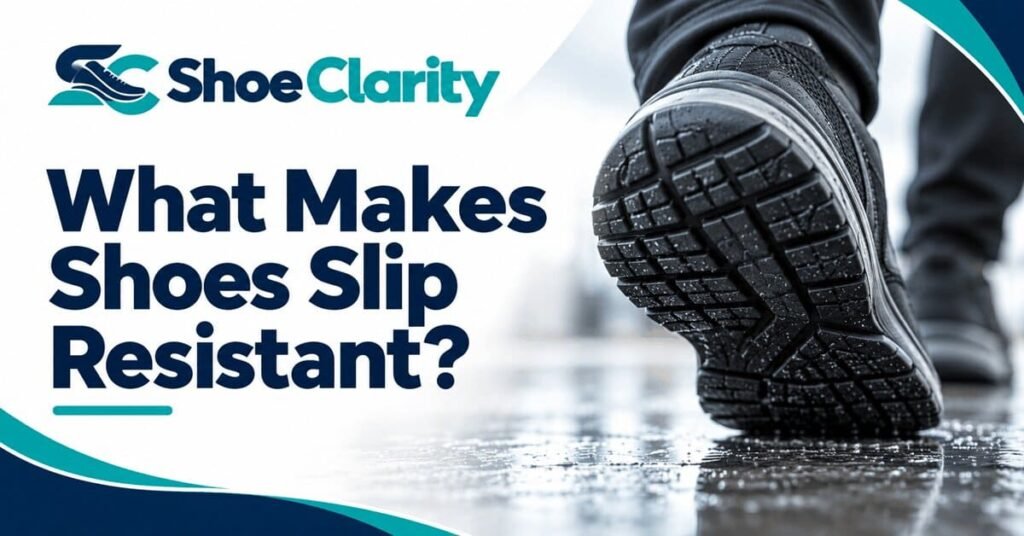
A shoe can have deep tread and still slide on a greasy restaurant floor. What makes shoes slip resistant is the way its outsole compound and tread design interact with a particular surface, especially when water, oil, or debris gets between the shoe and the floor. Fit, wear, and walking conditions affect the result, too.
The short answer: look beyond the word non-slip. No shoe prevents every slip, and an attractive tread pattern does not prove tested performance. Here is what actually matters and how to check a claim before buying work footwear.
What Is a Non-Slip Shoe?
A non-slip shoe is footwear designed or marketed to improve traction on walking surfaces where slipping is a concern. Non-slip and slip-resistant are common retail descriptions, not promises that a fall cannot happen. Whether a particular shoe works well depends on the outsole, the floor, and the conditions of use.
Consider two shoes that look similar: an ordinary sneaker and a work sneaker designed for food-service floors. Both may have rubber soles, but only one may provide relevant testing information for wet or oily tile. Appearance alone cannot settle the difference.
When a workplace requires non-slip footwear, check the employer’s policy and the exact product model rather than assuming any rubber-soled shoe qualifies.
What Makes Shoes Slip Resistant?
The central factor is friction, the resistance between the outsole and the surface beneath it. On a clean, dry floor, rubber may make close contact with the surface. Add liquid or residue, and that contact can change dramatically.
Friction Between the Shoe and Floor
A laboratory may report friction using a coefficient of friction (COF). Under comparable test conditions, a higher measured COF generally indicates greater resistance to sliding. But a number without its test method, floor material, and contaminant tells you very little. Results from different procedures should not be treated as interchangeable.
Think about a server stepping from dry dining-room flooring into a kitchen where a thin film of grease remains after cleanup. The shoe has not changed, but its traction may have.
Why Water and Grease Matter
A liquid layer can separate parts of the outsole from the floor. Tread channels may help displace fluid so more of the sole contacts the surface. Water and cooking oil behave differently, however, and their effects also depend on speed, load, rubber, and tread geometry.
A NIOSH-hosted research summary on shoe-tread friction describes fluid pressure and the deformation of outsole material as important parts of this interaction. That is a stronger explanation than simply saying that deeper grooves always produce better grip.
How Outsole Rubber and Tread Patterns Affect Grip
Rubber Compounds and Flexibility
Not all rubber behaves alike. Compound formulation, hardness, and the ability to conform to small floor irregularities influence friction. A softer outsole may work well on some smooth, contaminated surfaces, but softness alone does not establish workplace suitability. A damaged or hardened sole can also perform differently from a new one.
The words sticky rubber or extra grip are not substitutes for model-specific evidence. Ask what surface and conditions support those claims.
Grooves, Siping, and Fluid Movement
Tread grooves provide spaces for liquid or debris. Fine cuts, sometimes called sipes, create additional edges and can change contact with the surface. A suitable combination of groove spacing and outsole material may help manage contamination on indoor floors.
One counterintuitive detail: the deepest, chunkiest tread is not always the best choice for a wet kitchen. Open lugs can be useful on loose outdoor ground, while closely spaced patterns may be more suitable for some smooth indoor surfaces. The UK’s Health and Safety Executive describes this distinction in its guidance on footwear selection for slippery workplaces. That guidance is useful technical context, not a US footwear-certification rule. Food residue can also clog a tread pattern. Design matters, but maintenance matters alongside it.
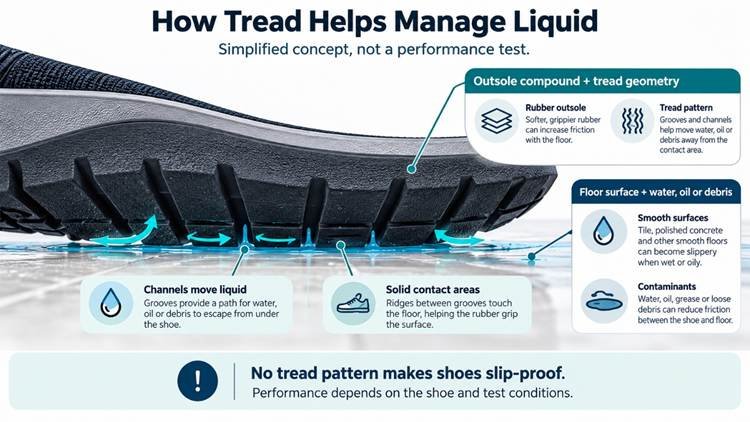
Original educational illustration: How Tread Helps Manage Liquid. The diagram explains possible liquid movement beneath an outsole. It does not represent laboratory testing or guarantee slip resistance.
Heel Shape and Secure Fit
An outsole works as part of a complete shoe. Heel geometry influences the first contact with the floor, while a secure fit helps the shoe stay on the foot during turns and quick changes of direction. A loose heel is not something an aggressive tread can fix.
Check the closure, heel security, and your workplace’s footwear requirements as well as the outsole.
Slip Resistant vs Non Slip: Is There a Difference?
For most US shoppers, slip resistant vs non slip is primarily a difference in wording. Neither phrase automatically identifies a particular laboratory standard or guarantees performance on all surfaces.
| Term | Common use | What it does not establish |
| Non-slip | Consumer-facing description of footwear intended to improve grip | That the shoe is slip-proof or passed a specific test |
| Slip-resistant | Common term in occupational footwear and product specifications | That every product using the label meets the same requirements |
A manufacturer might publish relevant performance documentation. Another might offer only a label. Compare the specific shoes and evidence, not the adjectives. The distinction matters when a workplace policy uses one term and a product label uses the other.
Which Shoes Are Considered Non-Slip?
When people ask what shoes count as non-slip, the answer depends on the specific product, not a style category. Work sneakers, closed-back occupational clogs, and other purpose-designed work shoes may be sold as slip-resistant footwear. But an entire style is not automatically slip-resistant. A fashion clog and a food-service clog can look alike while having very different outsole specifications.
The same applies to running shoes. Visible lugs or a rubber outsole do not prove suitable traction on oily commercial-kitchen tile. The useful questions are whether the exact model is intended for that environment, whether its claims are supported, and whether it meets your employer’s requirements.
If you’re choosing shoes for restaurant work, a product’s model-specific documentation is more meaningful than its category label.
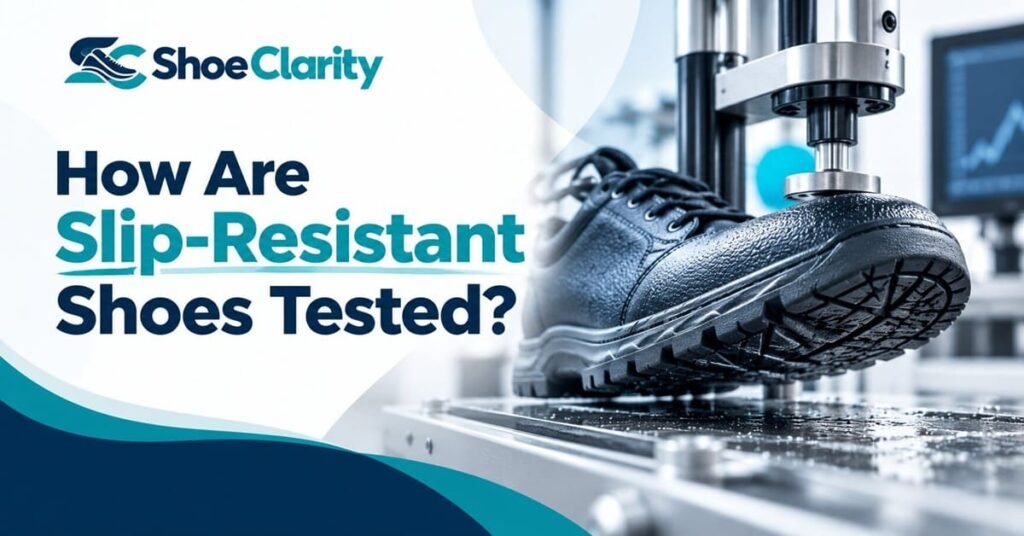
How Are Slip-Resistant Shoes Tested?
Testing offers a way to evaluate friction under defined conditions. It does not recreate every movement, spill, or worn floor a person may encounter at work.
ASTM F2913: Measuring Whole-Shoe Friction
ASTM F2913-24 is a test method for evaluating friction between footwear and selected test surfaces using a whole-shoe tester. ASTM identifies the method and its scope on the official footwear friction-testing page.
A result should be interpreted with its test surface and conditions. A wet-surface result cannot simply be treated as proof of equal performance on oily floors, and a single COF value without context is not a universal safety score.
ASTM F3445: Performance Requirements
ASTM F3445-24 is a separate specification addressing minimum performance requirements when slip-resistant footwear is evaluated using the F2913 test method. The distinction is shown in the ASTM performance specification listing.
F2913 describes a way to test; F3445 provides performance requirements. A product advertised as “tested using F2913” has not, on that statement alone, demonstrated that it meets F3445. Ask for the actual claim and supporting information.
How to Read Common Slip-Resistance Claims
| Claim on a product page | What the claim may tell you | What still needs checking |
| “Non-slip outsole” | The seller markets the shoe for better grip. | Relevant test conditions or model-specific evidence. |
| “Tested using ASTM F2913” | A friction test method was used. | The results, surfaces, contaminants, and whether any performance specification was met. |
| “Meets ASTM F3445” | The manufacturer claims the footwear satisfies a performance specification. | The exact model, edition, and supporting compliance documentation. |
A test method is not a certificate by itself. For any claim, keep the specific shoe model and stated conditions in view.
What to Ask About a Testing Claim
Look for the exact model, cited standard and edition, tested surface, contaminant, and the manufacturer’s reported result or compliance statement. Avoid accepting an unexplained COF number or a generic “slip-proof” badge. Do not assume a particular pass threshold without checking the applicable standard.
That evidence-based approach is especially valuable when your employer specifies an approved shoe type.
How to Tell If Your Shoes Are Slip Resistant
You cannot verify laboratory performance by inspecting a photograph. You can narrow down the options before buying:
- Identify the exact model. Start with its manufacturer’s specifications, not just a retailer’s product title.
- Match the hazard. Wet tile, oily kitchen floors, loose gravel, and ice are different conditions.
- Check the evidence. Look for relevant testing or a clearly explained slip-resistance claim.
- Inspect the outsole. Note the tread design, visible wear, damage, and trapped debris.
- Confirm fit and policy. The shoe should stay secure and meet workplace rules.
Imagine choosing between two black restaurant shoes. Both look appropriate for a uniform. One lists the tested conditions for its outsole; the other promises “maximum grip” without details. The first gives you more information for a responsible decision, even though it cannot guarantee you will never slip.
Why Floor Conditions Change Slip Resistance
A useful shoe for one surface may be a poor match for another. This quick comparison explains why.
| Surface or condition | Main concern | What to look for |
| Dry indoor flooring | Sole-to-floor contact | Fit and suitability for the surface |
| Wet tile | Liquid film reducing contact | Relevant wet-floor performance evidence |
| Oily restaurant flooring | Grease or cooking oil | Evidence for comparable oily conditions |
| Loose outdoor ground | Shifting particles | Appropriate outdoor tread design |
| Ice or snow | Different traction demands | Footwear intended for winter conditions |
One shoe may handle a wet surface well but perform differently in grease. That is not necessarily a contradiction. It reflects how the contact conditions change. If your workplace has recurring spills, footwear selection should be paired with floor cleaning and other controls.
How to Maintain Slip-Resistant Outsoles
A shoe’s original grip is not permanent. Worn tread, accumulated debris, and damaged outsole material can change how the sole meets the floor. Clean it according to the manufacturer’s instructions, inspect it regularly, and follow employer or supplier guidance for replacement.
There is no reliable universal replacement date for every work shoe. A pair used daily on abrasive floors may deteriorate differently from one worn only occasionally.
Avoid trying to turn ordinary sneakers into certified slip-resistant work shoes by sanding the sole or applying an unverified coating. A home modification cannot demonstrate compliance with a footwear performance specification, and it may damage the outsole.
Why Slip-Resistant Footwear Matters for Restaurant Workers
In food service, the hazard can change within minutes. Water near a dishwasher, spilled drinks by a serving station, and grease near cooking equipment do not create identical traction conditions. A floor can even look clean while a thin residue remains.
There is meaningful workplace evidence for appropriate footwear. A CDC/NIOSH account of a US food-service intervention describes a study involving roughly 17,000 workers across 226 school districts. Districts provided with highly rated slip-resistant shoes at no cost to workers experienced a 67% reduction in workers’ compensation injury claims associated with slipping on wet or greasy floors. The comparison districts did not see the same decline.
That figure describes a particular study and outcome. It does not mean any shoe will prevent 67% of falls in every restaurant.
Footwear is only part of prevention. OSHA’s restaurant clean-up safety guidance also emphasizes controlling spills and keeping walking surfaces safe. Employees should follow site-specific policies, while employers remain responsible for workplace protections.
When choosing footwear for a restaurant shift, compare models against the actual conditions and duties of the job. A label is only the starting point.

Frequently Asked Questions
Are Rubber Soles Always Slip Resistant?
No. Rubber compounds, tread patterns, surfaces, and wear differ. A rubber outsole alone does not prove tested slip resistance.
Can Regular Running Shoes Work in Restaurants?
Possibly in some roles if the employer permits them, but ordinary running-shoe tread does not establish performance on greasy or wet kitchen floors. Check the exact model and workplace rules.
Does Oil-Resistant Mean Slip-Resistant?
No. Oil-resistant can describe a material’s resistance to damage from oil. Slip-resistant describes traction-related performance. The HSE guidance on outsole claims explicitly distinguishes these properties.
Do Slip-Resistant Work Shoes Work on Ice?
Not automatically. A shoe designed for wet indoor floors may not provide adequate traction on ice. Follow winter-surface guidance and use footwear designed for those conditions.
The Bottom Line
What makes shoes slip resistant is the relationship between outsole material, tread geometry, the walking surface, and conditions such as water, grease, and wear. Neither a rubber sole nor a “non-slip” label proves that a shoe will perform well everywhere.
If you are choosing shoes for restaurant or other workplace use, start with the exact model, the conditions on your floors, and any supporting test information. Compare those facts before price or appearance. For a closer look at how we examine footwear claims without hands-on testing, read our research approach.