Disclosure: Shoe Clarity is reader-supported. As an Amazon Associate, we earn from qualifying purchases. We may also earn commissions from other affiliate programs, at no additional cost to you. Learn more →
Restaurant work can take you from a dry dining room to wet tile near the dishwasher and greasy flooring beside the kitchen. A shoe that feels comfortable while standing still may be awkward when you turn quickly with a tray.
If you’re wondering how to choose shoes for restaurant work, start with your employer’s footwear rules and the floors you actually cross. Then compare model-specific slip-resistance information, fit, stability, foot protection, and cleaning needs. The right pair is not automatically the softest, most expensive, or most aggressively treaded.
This guide gives you seven practical checks before you buy, without mistaking a marketing label for proof of safety.
What Should You Look for in Restaurant Work Shoes?
Good restaurant work shoes match the job, rather than just looking suitable for a uniform. A server crossing between the dining room and kitchen may value secure fit and walking comfort. Someone washing dishes may put more weight on wet-floor traction and an upper that tolerates frequent splashes.
Use these seven checks to compare options before paying:
| Priority | What to check | Why it matters |
| Workplace rules | Approved styles, color, closures, and protective requirements | A comfortable shoe is not useful if it fails your employer’s policy |
| Floor conditions | Wet, oily, smooth, uneven, or changing surfaces | Outsole performance depends on the surface and contaminant |
| Slip resistance | Model-specific claims and relevant test information | A generic “non-slip” label is not a guarantee |
| Fit | Heel hold, toe room, width, and instep security | Your foot should not slide around inside the shoe |
| Comfort and stability | Cushioning, underfoot support, and a stable base | Long shifts involve standing, walking, and turning |
| Upper and protection | Coverage, resistance to splashes, and cleaning needs | Different stations create different hazards |
| Durability and value | Outsole wear, construction, care, and replacement cost | The cheapest initial price may not be the best fit for the job |
Treat workplace rules, floor hazards, and a secure fit as pass-or-fail checks. Compare comfort, style, and price only among shoes that pass them.
7 Things to Check Before Choosing Restaurant Work Shoes
1. Check Your Employer’s Footwear Requirements
Before browsing shoes, ask what your workplace accepts. Some restaurants specify black shoes, closed toes, closed heels, or slip-resistant outsoles. Others maintain an approved-product list or have stricter requirements for particular stations. Your manager or employee handbook should settle those details.
US restaurants do not all follow one footwear policy. OSHA’s advice on restaurant slip hazards recommends appropriate shoe policies alongside safe floors, but it does not identify a single mandatory shoe model for every employee.
Protective-toe footwear is a separate decision. Under OSHA’s foot-protection rule, employers must ensure protective footwear is used where specified hazards, including falling or rolling objects, punctures, or electrical dangers, are present. That does not make steel-toe shoes mandatory for every server.
Before you shop, get a clear answer to this question: Which features are required at my station, and which are simply preferences?
2. Match Slip Resistance to Your Floor Conditions
Restaurant floors do not present one consistent traction problem. Dry dining-room tile, a puddle near the ice machine, and greasy flooring near a fryer create different contact conditions between a shoe and the ground.
Look for slip-resistant shoes for restaurant workers with evidence relevant to the floors they will encounter. A manufacturer may describe a sole as non-slip or oil-resistant, but those labels alone say little about performance on a specific wet or oily surface. In particular, an oil-resistant material is not necessarily a slip-resistant one. The UK’s Health and Safety Executive makes that distinction in its footwear-selection guidance for contaminated floors.
If a seller cites ASTM F2913, ask for results for the exact model and relevant surfaces or contaminants. Being tested by a method is not the same as meeting a performance requirement. ASTM’s footwear performance specification also cautions that laboratory compliance cannot establish performance in every real-world situation.
For more on the underlying friction, grooves, and testing terms, our guide to how outsole design affects grip explains the technical side. Here, your decision is simpler: match the evidence to the actual work environment.
Good footwear cannot replace prompt spill cleanup or safe floor maintenance. That makes the job’s daily conditions the next thing to examine.
3. Choose the Right Fit, Width, and Toe Room
A secure shoe should hold your heel without crushing your toes. Your forefoot needs room to move naturally, but the shoe should not let your whole foot slide forward every time you stop or change direction.
When considering how work shoes should fit, pay attention to four places: the heel, the widest part of the forefoot, the toe box, and the instep where the shoe fastens. A comfortable heel is not enough if the toes hit the front; a roomy toe box does not help if your heel lifts with every step.
The Canadian Centre for Occupational Health and Safety provides useful general workplace shoe-fit advice, including checking both feet, allowing toe movement, and not relying on tight footwear to stretch. It is practical fit guidance, not a statement of US legal requirements.
Try shoes with the socks you actually wear on shift. If you use an insole, verify that it fits without crowding your foot and that any change remains consistent with the manufacturer’s instructions. A comfort label cannot rescue a poor fit.
4. Balance Cushioning, Support, and Stability
Hard restaurant floors can make a long shift tiring. Cushioning may help a shoe feel more comfortable, while a secure heel and stable sole matter when you turn, carry items, or move through crowded aisles.
Here’s the thing: more cushioning is not automatically more useful. A tall, very soft midsole might feel inviting in a store yet feel less controlled during quick sideways movements. On the other hand, a rigid shoe with little underfoot comfort may be unpleasant for workers who spend much of the day standing.
Rather than chasing a single “best” level of arch support, compare how the shoe feels under your foot and whether the platform feels secure. Think about the difference between a host standing at one station and a food runner crossing the restaurant repeatedly. Both need comfort, but they move differently.
For persistent foot pain, seek individualized professional advice rather than expecting a shoe feature to fix it. Otherwise, prioritize comfort that does not compromise secure movement.
5. Choose an Upper That Suits Spills and Cleaning
Spills reach the upper, not just the sole. Water, sauces, grease, and cleaning products make upper material a practical choice.
Smooth leather and some synthetic uppers may be easier to wipe clean than open mesh. Mesh can allow more airflow, but porous fabric may be a poor match where hot spills are a concern. OSHA’s guidance for cooking-area hazards specifically warns about open-toe and porous footwear around hot liquids.
Water-resistant and waterproof also mean different things. Water resistance may help with occasional splashes; waterproof construction aims to limit water entry under stated conditions, but it does not make a shoe slip-proof or necessarily comfortable for every shift. A dishwasher might need more liquid protection than a host, while someone working in a hot kitchen may weigh breathability alongside coverage.
Check the maker’s cleaning instructions before buying. If your shoes will collect food residue daily, easy maintenance is not a small detail.
6. Compare Shoe Style, Closure, and Foot Protection
Work sneakers, slip-on shoes, and occupational clogs can all appear in restaurant settings. None of those categories is automatically acceptable or safe for every role.
A lace-up work sneaker may offer adjustable instep hold. A slip-on can be convenient but must still grip the heel securely. Some occupational clogs have closed backs or retention features, while open-backed designs may not meet workplace policy or provide the secure fit a busy station demands.
Choose by features first. Does the shoe stay in place when you turn? Does the upper protect your foot from the hazards at your station? Can you fasten it firmly? Does it meet the employer’s uniform and safety rules?
A sleek black upper may satisfy the dress code while concealing a sole unsuited to greasy tile.
7. Check Durability, Care, and Overall Value
The cheapest pair on the shelf is not always the least expensive choice over time. An outsole that wears quickly, an upper that is hard to clean, or a shoe that never fits properly can make a low purchase price less appealing.
Inspect how the sole meets the upper, whether the tread is likely to trap debris, what cleaning method the manufacturer permits, and what the return policy covers. Look for specific construction or material information rather than vague promises of “lasting comfort.”
No universal replacement interval fits every restaurant shoe. Flooring, work hours, materials, and care all affect wear. Smooth tread patches and separating outsole edges call for a closer look, even if the pair is relatively new.
Now compare those priorities with your specific restaurant role.
Which Shoes Make Sense for Different Restaurant Jobs?
Your role changes the order of priorities. A shoe that suits a quiet reception station may be a weak choice for someone working next to a busy dish pit.
| Restaurant role | Features to prioritize | Questions to ask |
| Server or waiter | Secure heel, walking comfort, relevant traction, dress-code fit | Will it stay comfortable while carrying plates and crossing between rooms? |
| Chef or line cook | Appropriate grip, covered upper, easy cleaning, stable stance | Does it handle the station’s spills and hot-liquid exposure? |
| Bartender | Wet-floor suitability, secure fit, splash-tolerant upper | What happens around ice bins and drink spills? |
| Dishwasher | Wet-work suitability, water protection, grip, cleanability | Can it handle frequent splashing and the employer’s floor conditions? |
| Host or front desk worker | Professional appearance, comfort while standing, secure footing | Does it meet the uniform rules without sacrificing fit? |
| Busser or food runner | Secure closure, traction, movement comfort, durable upper | Is it practical for repeated turns and trips through crowded areas? |
These are starting points, not fixed rules about which type of shoe each employee must wear. A server who regularly helps with kitchen cleanup may need more liquid protection than someone who stays in the dining room.
One easily missed detail: the most slippery part of a server’s shift may be the ten steps past the dish area, not the dining room where most of the shift happens. Select footwear for the route you actually walk.
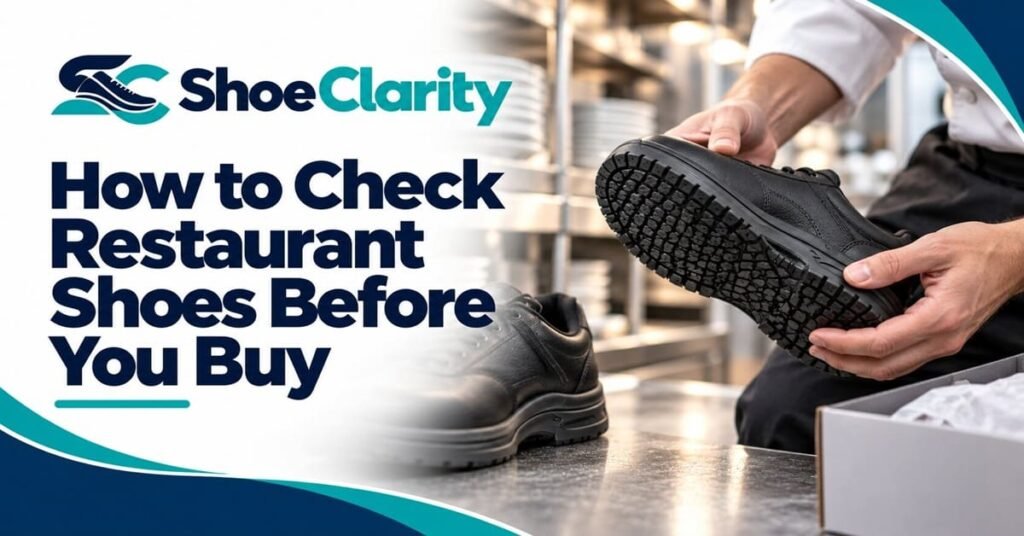
How to Check Restaurant Shoes Before You Buy
You cannot recreate laboratory slip testing in a store. You can use a five-minute try-on to catch fit and practicality problems before they follow you through a shift.
- Wear your work socks. Try both shoes, preferably after you have been on your feet for part of the day.
- Stand and check toe space. Your toes should move without hitting the front or squeezing together. Confirm the width feels right at the forefoot.
- Walk and turn on a safe, dry surface. Pay attention to heel lift, foot movement inside the shoe, and whether the sole feels stable. Do not deliberately test shoes on wet or greasy flooring.
- Inspect the exact product claim. Check the model, outsole details, and any described slip-resistance testing. If the seller supplies no supporting information, treat broad claims cautiously.
- Check everyday practicality. Can you clean the upper? Does the closure stay secure? Does the shoe meet your employer’s rules and allow a reasonable return if the fit fails indoors?
A try-on cannot predict a whole shift, but it can rule out obvious problems. If your heel slips during an ordinary walk, another color will not fix the fit. Narrow the shortlist to two or three models with appropriate features and clear specifications.
What Restaurant Workers Should Avoid When Choosing Shoes
A common shortcut is to accept “non-slip” on a product page as proof, or assume a regular running shoe works because its tread looks substantial.
Neither shortcut verifies performance on your floor. A regular sneaker might satisfy some workplace policies but still have no documented grip performance on greasy tile.
Also avoid buying a shoe that feels painfully tight, expecting it to stretch later. Do not choose an unsecured back solely for convenience if your job calls for a stable heel, and do not ignore how the material will handle spills and daily cleaning.
A useful shopping question is not simply “Are these good shoes?” It is “Which part of my job are these shoes designed to handle, and what evidence supports that choice?”
When Should Restaurant Work Shoes Be Replaced?
Replace or reassess footwear when tread has worn smooth, an outsole begins separating, the upper no longer protects as intended, or fit and heel support have noticeably changed. Persistent trapped food debris can also interfere with the outsole’s function, so follow the manufacturer’s cleaning guidance.
There is no single number of months or miles that works for every shoe and every shift. The HSE notes that slip resistance can change as footwear wears, making regular inspection more useful than an arbitrary replacement date.
A worn shoe is not the only hazard, either. OSHA’s cleanup guidance for restaurant work emphasizes housekeeping, attention to wet processes, and suitable footwear. Report spills and damaged flooring rather than expecting even a well-chosen outsole to compensate for them.

Frequently Asked Questions
Do restaurant workers need slip-resistant shoes?
Many restaurant roles benefit from appropriate slip-resistant footwear, particularly where floors may become wet or greasy. OSHA recommends non-slip shoes in its restaurant safety guidance, and employers may set their own footwear policies. Check your workplace’s requirements; do not assume one shoe model or specification applies to every restaurant job.
Can you wear regular sneakers to work in a restaurant?
Sometimes, if the employer permits them and they suit the actual hazards. But a standard running shoe is not automatically suitable for greasy or wet restaurant floors. Look at the specific model’s traction information, secure fit, upper, and workplace approval rather than relying on the sneaker label.
Are clogs or sneakers better for restaurant work?
Neither style always wins. Closed-back occupational clogs may be practical for some wet or spill-prone stations, while lace-up work sneakers can provide adjustable heel and instep security. The outsole’s relevant performance, foot coverage, fit, and your employer’s policy matter more than the style name.
Should restaurant work shoes be waterproof?
Not always. Waterproof or water-resistant construction can be useful around dishwashing or frequent splashes, but it may be unnecessary in drier roles. Match the upper to the work environment and consider coverage, breathability, cleaning, and traction separately. Waterproof does not mean slip-proof.
How should restaurant work shoes fit?
They should hold the heel securely, provide enough width and toe room, and feel stable while walking and turning. Try both shoes with your regular work socks, and avoid a pair that pinches or allows excessive movement inside. A secure fit is part of practical footwear selection, not an optional extra.
The Bottom Line
How to choose shoes for restaurant work comes down to matching footwear to the job in front of you. Start with the employer’s rules and the surfaces you cross. Then compare slip-resistance evidence, heel security, toe room, stability, upper protection, cleaning needs, and signs of lasting construction.
Don’t let a bold “non-slip” label or a low price make the decision for you. A shoe that meets the dress code but slides around your foot is a poor match; so is a comfortable shoe that cannot handle the hazards at your station.
Before you buy, shortlist models that satisfy the job’s requirements, check their supporting claims, and try them on carefully. If you’re comparing marketing promises with published specifications, see how Shoe Clarity evaluates footwear information so you know what evidence to look for next.